Instala la aplicación
How to install the app on iOS
Follow along with the video below to see how to install our site as a web app on your home screen.
Nota: Es posible que esta función no esté disponible en algunos navegadores.
Estás utilizando un navegador obsoleto. Puede que este u otros sitios no se muestren correctamente.
Debes actualizarlo o utilizar un navegador alternativo.
Debes actualizarlo o utilizar un navegador alternativo.
EL TRIUNFANTE
- Iniciador del tema Conn
- Fecha de inicio

con el permiso de Conn te contestoelpatron dijo:hola te queria preguntar si el grosor los clavos corresponden a la escala del barco

es muy dificil por no decir imposible realizar un barco completamente a escala,por ejeplo cuando realizamos la junta de calafeteo suele tener aprox 1 mm,esto en un barco a escala 1/90,seria 90mm,imaginate una junta de esa medida,pues con los clavos pasa lo mismo,bueno con muchas cosa,el amigo Conn esta realizando un modelo y esta simulando como iba el claveteado,independientemente si esta un poco fuera de escala
perdon por haberme entrometido
:wink:
Conn
Referente
Conn dijo:elpatron dijo:te queria consultar en que escala esta el modelo , porque me parece que son muy grandes los agujeros de los clavos
La escala es 1:72 en cuanto a la clavazón, es un tema que ya se deliberó mucho al comienzo del hilo con otros foristas. Al final me decanté por hilo de latón de 0,8mm, me hubiese gustado más de 0,75mm pero no encontré el adecuado.
De hecho en la obra viva, debería haber colocado cabillas de madera y no clavos de metal, pero rehusé por motivos estéticos (además en realidad las cabillas deberías ser más grandes que los clavos)
En las últimas fotos quiás parecen más grandes pero ten en cuenta que están tomadas muy de cerca. Si ves el barco en vivo no destacan en absoluto.
Saludos
Creo que ya te contesté a tu pregunta....
Conn
Referente
Curro dijo:con el permiso de Conn te contestoelpatron dijo:hola te queria preguntar si el grosor los clavos corresponden a la escala del barco
es muy dificil por no decir imposible realizar un barco completamente a escala,por ejeplo cuando realizamos la junta de calafeteo suele tener aprox 1 mm,esto en un barco a escala 1/90,seria 90mm,imaginate una junta de esa medida,pues con los clavos pasa lo mismo,bueno con muchas cosa,el amigo Conn esta realizando un modelo y esta simulando como iba el claveteado,independientemente si esta un poco fuera de escala
perdon por haberme entrometido
Exacto, gracias Curro :wink:
Conn
Referente
isidro dijo:aparte que los clavos para las cintas son mas grandes que los del costado, exactamente son de 23mm de grosor y la cabeza estaría cerca de los 40 mm de diámetro.
Para que se notase la diferencia me tendría que ir a un grosor de 1mm, lo encuentro excesivo. Creo que usaré el mismo que en el forro, aunque lo miraré a ver como queda.
Debo encontrar el equilibrio entre lo estético y la escala
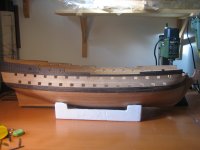
Ya he terminado de forrar la 1ª cinta, me falta precisamente los clavos, pero lo voy a meditar.
En cuanto a la 2ª cinta, en teoría son dos hiladas (tres sería demasiado), como mi inglés es malo y no he encontrado traductor a tu post, de momento lo dejo estar un tiempo, al final si nadie dice algo en contra creo que las haré lisas.....pero bueno lo meditaré también.
Archivos adjuntos

zapalobaco
Leyenda
Muy bien, Muy bien, Muy bien, Muy bien, Muy bien, Muy bien, .............................................¡Muy bien!
Conn
Referente
zapalobaco dijo:Muy bien, Muy bien, Muy bien, Muy bien, Muy bien, Muy bien, .............................................¡Muy bien!
Me alegra que te guste Zapa


Conn
Referente
ramon dijo:Es distinto a todo... me gusta muchísiimo
Gracias Ramón, tu tienes mucha "culpa" de que el barco haga esta singladura, sin tu asesoramiento esto sería imposible.
También debo agradecer a Isidro y a otros foreros su gran colaboración desinterasada.
Ahora miro atrás y ya ha pasado un año desde que comencé el modelo, quien me lo iba a decir.... para ser mi primer modelo en planos estoy francamente satisfecho.
Intentaré plasmar todo el rigor histórico que me sea posible a la hora de abordar la arquitectura naval del siglo XVIII de Jorge Juan y Ricardo Rooth, aún tengo muchas lagunas y queda mucho trabajo por delante.
Esto se está convirtiendo en un proyecto muy interesante para mi del que estoy aprendiendo muchas cosas y espero que al publicarlo pueda ser igualmente interesante para los demás.
Conn dijo:Esto se está convirtiendo en un proyecto muy interesante para mi del que estoy aprendiendo muchas cosas y espero que al publicarlo pueda ser igualmente interesante para los demás.
No lo dudes ni por un momento :wink:

fraco
Referente
Yo es que me quedo sin palabras.
zapalobaco dijo:Muy bien, Muy bien, Muy bien, Muy bien, Muy bien, Muy bien, .............................................¡Muy bien!
Requetebién.
En cuanto al asunto de la escala y la fidelidad a los detalles, hay que ser realista y fijarse un nivel, decir: yo quiero llegar hasta aquí y basta.
El pretendener hacer algo exacto al 100% exigiría trabajar a escalas mayores (1:10 por ejemplo) porque en caso contrario estaríamos haciendo auténtica miniaturización, de forma que ya no solamente hay que enfrentarse a la dificultad intrínseca que ello tiene, sino que también habría que resolver de algún modo las limitaciones de los materiales utilizados.

Javier García
Implicado
Rafael, te esta quedando, francamente sensacional, sin palabras, enhorabuena.
Saludos
Javier
Saludos
Javier

isidro dijo:Construction & Fitting of the english Man of war dijo:The Channel Wales
Confusion as to which wale was the channel wale is understandable due to the alteration of the level at which the channels were Fitted The simplest way of preventing confusion is to remember that the channel wale was the wale to which the chains of ihe shrouds were secured. This did not really concern ships with a single gundeck. On vessels with two complete gundecks built or altered according to the 1745 order to raise the channels, the channel wale was between the lower and upper gundecks. whereas on three-decked ships it was between the middle and upper gundecks. However, care must be taken when considering ships dating from a little before or after this date, as further alterations were made particularly to First Rates The channel wale on a three-decker was made up of three strakes of straight planking, each loin wide. The length of the planks was 25ft. care being taken to ensure that the burts did not lie under any of the upper deck ports. Some builders preferred the lower strakes wrought in either top and butt or anchor stock. In this case the width of the plank at the touch would be 13 in, making the butts 7in wide. No matter which method was employed, the thickness of the planks was approximately three-quarters of the thickness of the main wale.
The channel wale on two-deckers was generally wider than that of a First Rate ship. Usually it was 3ft wide, made upof three strakes of parallel planking in lengths of 28ft and 30ft. If the lower two strakes were wrought in top and butt or anchor stock, the overall width of the strake would be 2ft, thus making the width of the touch 16 in. and the butts 8 in. The plank thickness was as already described. The planking was secured to the timbers by exactly the same method that was used for the main wales. The upper strake of straight plank was given a shift of one-quarter of the length of the plank. If laid in parallel strakes, the shift of the butts was one-third of the length of the plank.
CINTAS DE LA MESA DE GUARNICIÓN
La confusión en cuanto a que cinta era cinta de mesa de guarnición es comprensible debido al cambio del nivel en el cual las mesas de guarnición fueron elevadas. La manera más simple de prevenir la confusión es recordar que las cintas de las mesas de guarnición eran las cintas a las cuales las cadenas de las vigotas estaban aseguradas. Esto no se refirió realmente a las naves a una sola bateria. En los navíos con dos baterías (completos) construidos o modificados según la orden 1745 para elevar las mesas de guarnición, las cintas de la mesa de guarnición estaban entre la batería baja y la superior. Considerando que en las naves de tres cubiertas estaba entre las baterias media y superior. Sin embargo, hay que tener cuidado al tomar en consideración la datación de naves de un poco antes o después de esta fecha, la mayoría de las alteraciones fueron hechas particularmente a los navíos de primera clase.
Las cintas de mesa de guarnición en un tres-puentes se componía de tres hiladas de tablazón recto, (each loin wide) cada lomo ancho?. La longitud de los tablones era de 25ft. cuidando de asegurarse de que los extremos no quedaran debajo de las portas de la cubierta superior. Algunos constructores prefirieron las hiladas más bajas labradas en top and butt o en anchor stock. En este caso la anchura del tablón en el centro sería de 13 pulgadas, haciendo los extremos de 7 pulgadas de ancho. No Importaba el método empleado, el grueso de los tablones eran aproximadamente tres cuartos del grueso de la cinta principal.
La cinta de mesa de guarnición en los dos-puentes era generalmente más ancho que el de una nave de la primera clase. Era generalmente de 3ft de ancho, hecho de mas de tres hiladas de tablaje paralelo en longitudes de 28ft y 30ft. Si las dos hiladas más bajas estaban labradas en top and butt o en anchor stock. la anchura total de la hilada sería los 2ft, siendo así la anchura del centro de 16 pulgadas y en los extremos de 8 pulgadas. El grueso del tablón sería según lo ya descrito. El tablaje estaba asegurado a las cuadernas, exactamente por el mismo método que se utilizó para la cinta principal. La hilada superior de tablón recto terminaba a un cuarto de la longitud del tablón. Si estuvieran colocadas paralelamente las hiladas, la unión de los extremos eran en la mitad de la longitud del tablón.
Archivos adjuntos
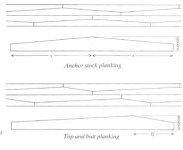
Yo entiendo en el texto que la cinta bajo las mesas de guarnición, se componia de hiladas de tracas que o bien eran todas rectas o las dos mas bajas se podían labrar por lo cual no era el mismo sistema que en la cinta principal, en la que si no me equivoco todas estaban labradas.
eso siempre y cuando se pueda extrapolar a la construcción de Jorge Juan, ya que parece que es un sistema que elegía cada constructor, según lo que aparece en el texto.
eso siempre y cuando se pueda extrapolar a la construcción de Jorge Juan, ya que parece que es un sistema que elegía cada constructor, según lo que aparece en el texto.
Conn
Referente
Mil gracias por la traducción y los comentarios.
Entonces por lo que entiendo se pueden hacer rectas, que es en principio como las quiero hacer.
¿son cuatro hiladas también en la cinta de las mesas de guarnición?
Tengo un problema de espacio entre las troneras de 1ª y 2ª batería, no me van a caber las 4 hiladas salvo que las tracas sean mucho menos anchas que la cinta principal
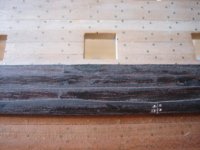
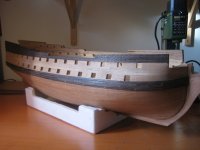
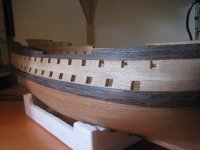
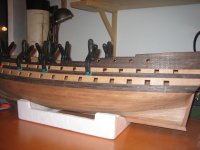
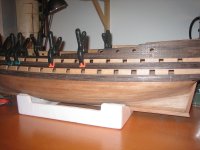
En las fotos se ven dos pruebas, una con dos hiladas y otra con tres hiladas (las tracas las debo reducir de ancho un pelín para que sean iguales a las de la cinta principal)
¿cómo se ve mejor con 2 o con 3 hiladas? o debería hacer 4 hiladas con tracas menos anchas.
Que os parece??
Entonces por lo que entiendo se pueden hacer rectas, que es en principio como las quiero hacer.
¿son cuatro hiladas también en la cinta de las mesas de guarnición?
Tengo un problema de espacio entre las troneras de 1ª y 2ª batería, no me van a caber las 4 hiladas salvo que las tracas sean mucho menos anchas que la cinta principal
En las fotos se ven dos pruebas, una con dos hiladas y otra con tres hiladas (las tracas las debo reducir de ancho un pelín para que sean iguales a las de la cinta principal)
¿cómo se ve mejor con 2 o con 3 hiladas? o debería hacer 4 hiladas con tracas menos anchas.
Que os parece??
Archivos adjuntos

jmolinas
Referente
a mi me gusta con las tres tracas. Queda mucho más proporcionado.

Conn dijo:En las fotos se ven dos pruebas, una con dos hiladas y otra con tres hiladas (las tracas las debo reducir de ancho un pelín para que sean iguales a las de la cinta principal)
en la foto pouedes comparar el ancho de unas y otras